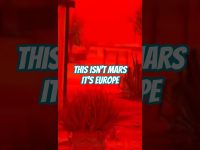
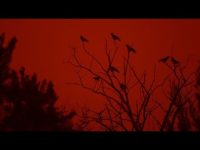













The sky over Europe just turned red. Not a little pink at sunset — fully, deeply, hauntingly red. Cities across the Mediterranean looked like they had been dropped onto the surface of Mars overnight, and millions of people woke up to one of the most surreal atmospheric events on record.
But this isn’t a disaster. It isn’t pollution in the traditional sense. And it definitely isn’t the apocalypse.
What you’re seeing is called a Redout — a rare but scientifically fascinating collision between a powerful storm system, the world’s most intense dust source, and the basic physics of light itself.
It starts in the Bodélé Depression in Chad. A vast, ancient lakebed sitting at the heart of the Sahara Desert, and the single most productive dust source on the entire planet. When Storm Erminio’s winds tore across this region, they acted like a planetary vacuum cleaner — pulling mineral-rich sand five kilometers up into the troposphere and carrying it north across the sea.
Then comes the physics. Normally, our atmosphere scatters blue light, which is why we see a blue sky. But pack that same atmosphere with dense Saharan dust particles, and everything changes. The short blue and violet wavelengths get scattered away. Only the long, deep red and orange waves make it through to your eyes. The result? A sky that looks like it belongs on another world.
And when that dust meets rain, it gets even stranger. Every raindrop captures a grain of sand and falls as a thin rust-colored mud — coating cars, streets, and buildings in a layer of ancient desert. Blood Rain. Completely natural. Completely eerie.
Here’s where it gets truly mind-bending though.
This same dust — the one turning European skies red and leaving a film of mud on everything — is also one of the most important delivery systems on Earth. Loaded with iron and phosphorus, it travels thousands of miles across the Atlantic Ocean every single year, and lands in the Amazon Rainforest. It is, quite literally, the fertilizer that keeps the lungs of our planet alive.
A storm in the Sahara feeds a forest in South America. And on its way there, it paints the skies of Europe red.
This is what a connected planet looks like. This is the Earth breathing.
Subscribe to Orizon Scope for more deep dives into the science behind the moments that make you stop and stare.
#OrizonScope #RedSky #SaharaDust #ScienceDocumentary #AtmosphericScience #WeatherExplained #RayleighScattering #EuropeWeather #EnvironmentalScience #NatureMysteries


0 Comments